

14|04|2025
FM Reconstruct
stem split technology

It's not uncommon to lose mixdowns, premasters, or even entire projects, leaving us with only the final master files - yet we still want to work on those songs, most often to remix and remaster them. After successfully reconstructing the audio of several major projects over the past year, I've decided to finally give this service a name and offer it publicly. As the word 'reconstruct' suggests, it involves reverse-engineering a song using modern audio stem-splitting technology, allowing for a seamless remix and remaster of a mastered stereo file.
Let me break it down in detail. Stem-splitting technology has been around in some form for about 10 years, but until just a few months ago, it was never convincing enough for professional audio work. Even today, some of the most well-known tools, like iZotope RX, still don’t quite do it justice. After waiting ages for the stem-splitting process to finish, you often end up with stems that have a decent amount of bleed between them - so you're not really left with fully usable material. What changed the game for me was the latest update of Logic X Pro where they introduced stem splitter.

On the very same day the update went live, I received one of the biggest requests of my mixing and mastering career - from none other than Edo Maajka, arguably the No. 1 rapper in the Balkans, and his label Menart. They asked me to remaster his legendary 20-year-old album No Sikiriki both for vinyl press and digital streaming. It was a pleasant kind of pressure and a huge motivation to give my best in bringing the sound of this old album into the present. And while it already sounds pretty darn good for a 20-year-old production, there was still plenty of room for improvement. As I started listening and analyzing all those hits, I had a strong urge to dive into every musical element, to rebalance the drums, basslines, instruments, and especially vocals. But the original projects and mixdowns were lost in time and all I had were full-blown masters, some pushing as loud as -4 LUFS.
I started working on the intro track Sevdah O Rodama, which consists only of a guitar and Edo’s vocal. At that point, I hadn’t even considered using Logic’s stem split option, assuming it wouldn’t be good enough for me to actually use. Since the track wasn’t crowded with elements, I was able to control quite a few harsh resonances in both the vocals and the guitar. I also wanted to bring up the fundamental lows of the very thin-sounding guitar - boosting them by around 8 dB. That worked well, but along with the guitar’s low end, I also brought up some very audible vocal plosives that hadn’t been noticeable before. Not doing low cut filtering on vocals 20 years ago was not a big surprise to me. That’s when I got the idea to try using the stem split - just to create a separate vocal channel, isolate the plosive frequency range, and then flip the phase polarity to cancel them out in the main file. It worked perfectly, and the intro track was done.

The vocal stem sounded surprisingly good on its own, which made me even more curious to explore it further on the next tracks from the album. I jumped into the next track To Sam Ja, and right away I noticed that Edo’s vocals were very midrange-heavy and resonant, making him sound slightly detached and sitting above the hip hop beat, which itself felt a bit muddy. On top of that, there were some arrangement issues - most notably, the main bassline was randomly disappearing by about 70% in volume due to some phase cancellation on every few hits of the bass line throughout the entire song. In comparison to Sevdah O Rodama, this was a full song with drums, melodic samples, bass, and vocals. And aside from the issues I already mentioned, I had a strong desire to dive even deeper - so I started experimenting with the stem-split drums, bass, other instruments, and vocals, and was genuinely amazed that there was virtually no audio bleed. I was still a bit skeptical, though, about the slightly 'watery' sound artifacts present in each individual stem. However, when the stems were summed back together in playback, those artifacts seemed to reconnect within the audio and became inaudible again.
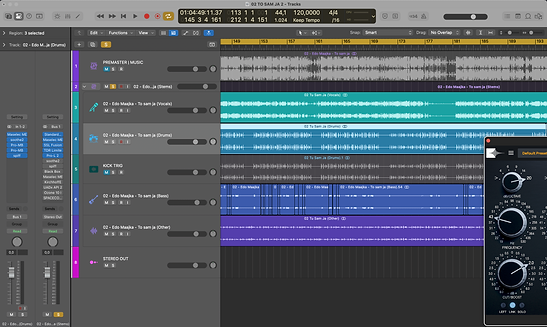
That got me curious: how much could I actually EQ, compress, widen, or even saturate each individual stem before the artifacts became audible once everything was summed back together?
So I ran a longer test on To Sam Ja, making some drastic changes, and I was blown away by how far I could push it. I was basically able to remix the entire song without introducing any noticeable artifacts. On top of that, working with separated stems gave me a whole new level of headroom, allowing me to push certain songs even louder by applying individual stem clipping, limiting, and other dynamic processing.
Coming back to the phasey bass issue in To Sam Ja, since I had the bassline isolated in its own stem, I was able to simply cut out the clean bass notes and replace the problematic ones throughout the song. This is a great example of how stem splitting, beyond just mixing and mastering, can also be a powerful tool for fixing arrangement issues within a track.
After completing this first complex remix and remaster using split stems, I had full confidence to continue working on the album this way, and the rest is history.
The next big project was remixing and remastering of another legendary 20-year-old album, which is yet to be released by Menart and talked about a lot very soon. Again, I used Logic’s stem split feature to do a stem remix and remaster. Just to mention a few more of the techniques this approach made possible: deeper transient detection and manipulation on the drum stem with plugins like Spiff or Split EQ, more advanced mid-side EQ on all stems, seamless sidechaining between clashing elements, and detailed spectral resonant control. None of these maneuvers introduced any audible artifacts in the final summed audio.
I didn’t want to rush into offering this as an official service in the studio until I had tested it on a few more projects. Now, after working on more than a dozen, I can confidently say that FM Reconstruct is a powerful option for sonically resurrecting any of your lost projects - provided you still have the master file. For more details, check out the Rates section on my website.
Disclaimer: Stem-splitting technology still isn’t perfect for using individual stems in completely new productions. The artifacts become noticeable when any of the stems are used in isolation, outside the context of their original mix.